





















Books That Inspired Their Masterpieces…..Okay, so here’s a thought I had while staring at my bookshelf (aka the leaning tower of “I swear I’ll read these soon”): every book we love probably has a secret parent. Like, you read Stephen King and think dang, this is wild — but somewhere in his teenage years, he was also curled up with some book that blew his brain wide open. And that book? It’s like the DNA of his masterpiece.
That’s kinda what this post is about — author picks: books that inspired their masterpieces. And I don’t mean it in some stiff, academic way. Nope. More like the way a chef swears by their grandma’s soup recipe. Or the way I (still) secretly write my “serious” essays like I’m channeling the chaos of my 9th grade English teacher who wore mismatched earrings and once yelled at a stapler.
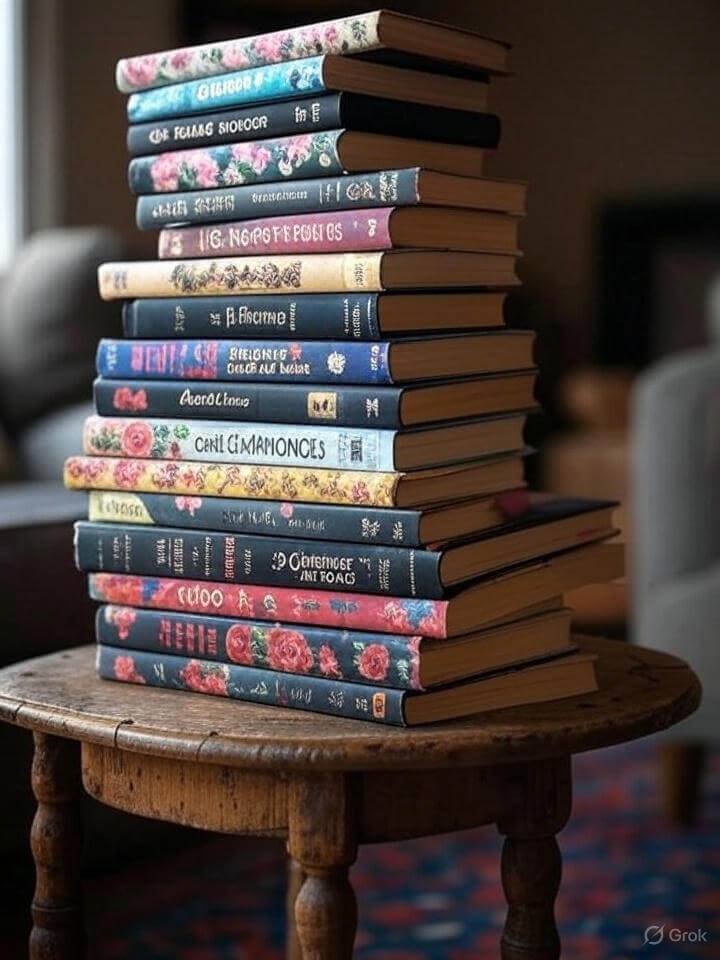
Anyway, here’s me pulling together stories of iconic authors and the Books That Inspired Their Masterpieces that lit their creative fire. Spoiler: some of them are obvious. Some are… not.
Stephen King + Lord of the Flies by William Golding
So, you probably already guessed King would pop up first. He’s basically the Godfather of “oh-crap-I-can’t-sleep-now” books. Turns out, one of the novels that shaped him was Lord of the Flies. Makes sense, right?
Boys stranded on an island, society crumbles, chaos erupts. It’s basically It but with coconuts. King once said Golding’s story made him realize that true horror isn’t about monsters—it’s about people. Which, honestly, is worse. Because you can’t exactly silver-bullet your neighbor when they’re being creepy. (Don’t try that. Bad advice.)
I still remember reading Lord of the Flies in 10th grade, my teacher circling words like “conch” on the board while half the class zoned out. Meanwhile, I was like, wait—did they just KILL Piggy? My brain cracked. King’s too, apparently.
Maya Angelou + Black Boy by Richard Wright
Maya Angelou had a way of writing that made your chest feel like it was cracked wide open. Turns out, one of the books that shaped her was Richard Wright’s Black Boy. She said his story gave her permission to speak her truth—loud, raw, unapologetic.
And you feel that connection if you read I Know Why the Caged Bird Sings. The rhythm, the honesty, the courage. Like, Angelou didn’t just read Wright’s book; she inhaled it and then exhaled her own life in sentences that make you stop mid-sip of coffee and just stare at the page.
Funny thing—I tried to read Black Boy on a flight once. Do not recommend. Turbulence plus existential dread equals me holding onto the armrest like it owed me money.
J.K. Rowling + The Little White Horse by Elizabeth Goudge
Okay, confession: I didn’t know this one until recently. J.K. Rowling has credited The Little White Horse as one of the books that shaped her imagination. I went down a rabbit hole (not literally, though I wouldn’t be shocked if that book had one) and it clicked. Magical worlds, courage, moral lessons. Sounds familiar?
It’s like seeing the baby photo of Harry Potter. You can trace the DNA. If The Little White Horse had never existed, would we still be debating Snape’s morality in 2025? Wild thought.
George R.R. Martin + The Lord of the Rings by J.R.R. Tolkien
This one’s obvious. Martin has said over and over that Tolkien was his guy. And yeah, duh—dragons, kingdoms, betrayal, epic battles. If Westeros had a family tree, Middle-earth would be its grandparent.
But here’s where it gets interesting: Martin took Tolkien’s grandeur and went, “Cool… but what if everyone’s morally gray and you can’t trust ANYONE?” Basically, Tolkien was like, “Here’s honor and courage.” Martin was like, “Sure, but also here’s some backstabbing and 400 named characters.”
Side tangent: I once tried to read The Silmarillion. My brain tapped out after three pages. Felt like being hit with a textbook disguised as a fantasy novel. Respect to anyone who got through it.
Haruki Murakami + The Great Gatsby by F. Scott Fitzgerald
Murakami writes novels where you’re never sure if you’re dreaming, awake, or just drank expired milk. But he swears The Great Gatsby was his turning point.
The melancholy. The obsession with the unattainable. The way beauty and sadness get tangled up like earbuds in your pocket. You can feel Gatsby’s green light pulsing somewhere in Murakami’s Norwegian Wood.
I tried re-reading Gatsby in my 20s (high school me didn’t get it). Suddenly, I was like… oh. Ohhh. It’s not about parties—it’s about that ache in your chest you can’t quite name. Murakami clearly got that too.
Toni Morrison + Madame Bovary by Gustave Flaubert
Morrison once said Madame Bovary gave her a framework for understanding character interiority. Which is fancy for “Flaubert crawled into Emma Bovary’s messy head and stayed there.”
And you see that DNA in Morrison’s work. Characters so layered they feel like real people you could bump into at the grocery store. Except they’d probably say something devastating that makes you cry in the cereal aisle.
I read Beloved in college, and I had to set it down like five times just to breathe. Then I googled Morrison interviews, and of course, she name-drops Madame Bovary. The chain reaction of influence is kinda beautiful.
Ray Bradbury + Winesburg, Ohio by Sherwood Anderson
Bradbury always felt like a guy who could find magic in a dusty carnival or an empty street at midnight. He said Anderson’s Winesburg, Ohio taught him that small-town lives could be epic. That you didn’t need flashy battles—just humanity, magnified.
Which explains Fahrenheit 451. Or Dandelion Wine. Reading those feels like Bradbury looked straight at a Tuesday afternoon and said, “You’re poetry.”
Side note: I once lived in a small town where the most exciting event was the annual “corn boil.” Bradbury would’ve made it sound like Shakespeare. Me? I just ate too much corn.
Sylvia Plath + The Bell Jar (…by herself?)
Okay, hear me out. I know this sounds like cheating. But Sylvia Plath’s influences get messy because her own voice was so singular. Yes, she read Woolf and Dickinson and Yeats. But honestly, when I think of Plath, I think of someone writing not because she was inspired by a book—but because she had no other choice.
Still, her journals show she was obsessed with Woolf. Makes sense. Both women knew how to take the quiet details of a day—tea, flowers, shoes—and turn them into ticking bombs of meaning.
James Baldwin + Uncle Tom’s Cabin by Harriet Beecher Stowe
Baldwin famously said Uncle Tom’s Cabin wasn’t great literature but it changed America. Which is such a Baldwin thing to say—sharp, witty, not pulling punches. And in a way, it fueled his mission: to write stories that were both art and activism.
When you read Go Tell It on the Mountain, you can feel Baldwin’s determination to take narratives about race and power and elevate them into actual literature. It’s like he looked at Stowe and went, “Nice try. Watch me do it better.”
Ernest Hemingway + The Adventures of Huckleberry Finn by Mark Twain
Hemingway once said, “All modern American literature comes from one book by Mark Twain called Huckleberry Finn.” Which, yeah, sounds like the most Hemingway thing ever—blunt, absolute, no commas wasted.
And honestly? He’s not wrong. Twain’s voice was raw, colloquial, unpolished. Exactly the thing Hemingway championed. You can trace that DNA straight into Hemingway’s short, punchy sentences.
I tried to copy that style once in college. My professor circled half my essay in red and wrote “too sparse.” Guess I wasn’t Hemingway enough.
So what’s the point about Books That Inspired Their Masterpieces?
Authors are like mixtapes. They’re layered, messy, full of influences you’d never expect. The books they loved shaped the books they wrote, and now we’re reading them and maybe getting inspired ourselves. It’s like literary dominoes. One book knocks into another, and suddenly, decades later, you’re holding something that wouldn’t exist without that first push.
And maybe that’s the whole beauty of it. None of us create in a vacuum. We’re all borrowing, remixing, stealing little sparks. (T.S. Eliot literally said, “Immature poets imitate; mature poets steal.” So… permission granted?)
Next time you pick up your favorite novel, ask yourself: what secret book-parent is hiding in the shadows?
Outbound Links: Books That Inspired Their Masterpieces
- Paulo Coelho interview — The Guardian
- Sylvia Plath bio & works — Poetry Foundation
- Original “Crying in H Mart” essay — The New Yorker
- James Clear’s 3-2-1 newsletter — James Clear
- Matt Haig’s blog — Matt Haig